Archaeotechnology Audit
Trade and Commerce in Ancient Civilizations: The First Global Networks
Lapis lazuli mined in Afghanistan turns up in Egyptian royal tombs two thousand miles away. Indus Valley seals surface in Mesopotamian cities. None of that happened by accident, and the physical trail left behind is more precise than most people expect.

Research Evidence
- Cuneiform tablet records (Sumerian & Akkadian)
- Harappan seal and weight excavation data
- Egyptian temple reliefs (Deir el-Bahari)
- Comparative Bronze Age trade scholarship
- Peer-reviewed archaeological journals
This investigation weighs physical trade evidence, seals, seeds, isotopes, inscriptions, against later literary retellings, and flags where scholarly identification remains genuinely unsettled.
A carved stone seal showing a humped bull, made in the Indus Valley, has been dug out of the ground in Ur, a Mesopotamian city more than a thousand miles away. That’s not a coincidence and it’s not a curiosity for a museum case. It’s a shipping receipt, of sorts, evidence that someone, likely several someones, moved goods across deserts, rivers, and open water long before anyone had a word for “globalization.” Trade in the ancient world wasn’t a side effect of civilization. In a lot of ways, it was the mechanism that let civilization happen at the scale it did, tying together river valleys separated by geography that should, by all rights, have kept them strangers to each other.
Early Harappan settlements establish standardized weights and dockyard infrastructure supporting regional exchange.
The world’s earliest writing system develops largely to record grain, wool, and trade transactions on clay tablets.
Lagash administrative texts record trade with Dilmun, likely modern Bahrain, a key intermediary station toward the Gulf.
Mesopotamian cuneiform tablets repeatedly mention Meluhha, generally identified with the Indus Valley Civilization, as a major trading partner.
Egyptian temple reliefs at Deir el-Bahari record a state-sponsored voyage returning incense, ebony, and exotic goods.
Coastal city-states of the Levant come to dominate Mediterranean sea trade and found colonies including Carthage.
Log 01
Mesopotamia: Where Trade Invented the Ledger

Cuneiform, Temples, and the Birth of Bookkeeping
Sumerian cities didn’t invent writing for poetry. They invented it for inventory. The earliest cuneiform tablets, dating to around 3100 BC, are overwhelmingly administrative: quantities of barley, wool, and oil, who owed what to whom, what shipment arrived and what didn’t. Trade wasnt just an economic activity that happened to leave records behind. It’s arguably the reason written language exists in the first place, since keeping track of long-distance exchange at scale requires a memory system bigger than any single merchant’s head.
Temples functioned as the era’s financial institutions, storing surplus grain and goods and organizing long-distance trade missions. Merchants sailed down the Euphrates or joined caravans bound for Dilmun, most likely modern Bahrain, a key waypoint on the route toward the Indus Valley. Luxury goods moved alongside staples: lapis lazuli, a deep blue stone prized across the ancient world, came from mines in what’s now northeastern Afghanistan, meaning a single stone might pass through several intermediary traders before reaching a Sumerian temple or, eventually, an Egyptian tomb.
Lapis lazuli found in Egyptian royal burials, including artifacts associated with Tutankhamun, was mined almost exclusively at Sar-i Sang in Badakhshan, in what’s now northeastern Afghanistan. That means the stone crossed a trade network stretching roughly 4,000 kilometers before it ever reached the Nile.
Log 02
The Indus Valley: Organized, Prosperous, and Still Partly Unreadable

Meluhha: The Trading Partner Mesopotamia Couldn’t Stop Mentioning
The Indus Valley Civilization, spanning roughly 2600 to 1900 BC, was among the most urbanized societies of its era, and archaeologists have found the infrastructure to prove it: standardized weights, carved stone seals, and dockyards suggesting organized, regulated exchange rather than informal barter. Carnelian beads, ivory, and cotton textiles moved westward from Indus workshops. What moved back is less clear, since very little Mesopotamian material has turned up on the Indus side, a gap some historians read as evidence that demand ran mostly one direction, from Mesopotamia toward Indus goods rather than the reverse.
Mesopotamian cuneiform tablets repeatedly reference a trading partner called Meluhha. Most scholars identify Meluhha with the Indus Valley Civilization, based on the sheer volume of Harappan-style seals and goods recovered from Mesopotamian sites like Ur. That identification isn’t universal, though, and it’s worth being upfront about the disagreement rather than presenting it as settled. The Indus script itself remains undeciphered, so historians are reconstructing this relationship almost entirely from the Mesopotamian side of the correspondence, without ever hearing directly from the Indus merchants themselves.
“Meluhha” is confirmed beyond doubt to be the Indus Valley Civilization, full stop, end of discussion.
Most scholars accept the identification based on strong circumstantial evidence: Harappan seals, cubical weights, and goods like carnelian beads appearing at Mesopotamian sites. But the Indus script hasn’t been deciphered, no Meluhhan-language texts have surfaced, and a handful of researchers have proposed alternative or more cautious readings. The consensus is strong. It isn’t unanimous.
Log 03
Egypt: The Nile as Highway, the State as Trader
Gold, Grain, and Royal Expeditions
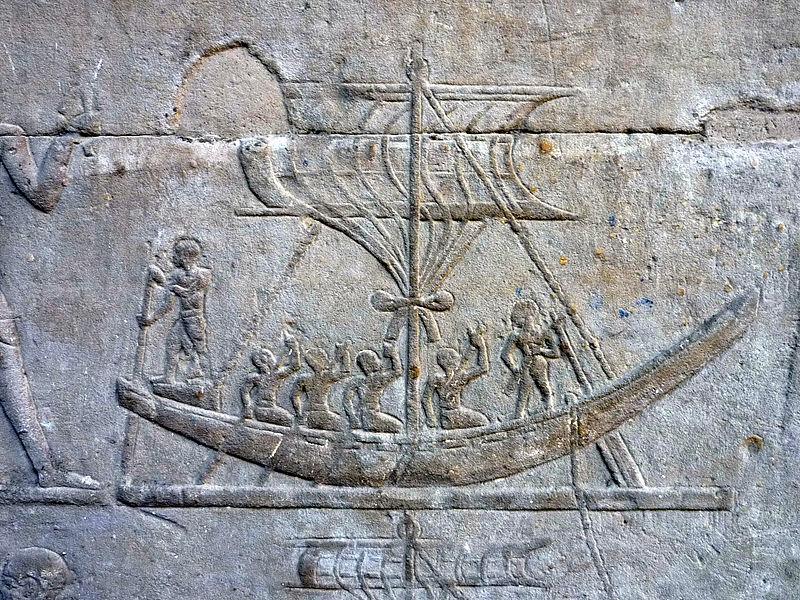
Egypt’s trade ran on two tracks at once: internal movement along the Nile, and external exchange with Nubia, the Levant, and a still-debated region ancient Egyptians called Punt. Exports included gold, linen, and papyrus. Imports ran the other direction, incense, ebony, and exotic animals among them. Control of Nubian gold mines and Red Sea access gave Egypt serious commercial leverage, but what really separates Egyptian trade from its neighbors is how centralized it was. This wasn’t a market of independent merchants competing for margins. Major expeditions were state-sponsored, organized under the authority of the pharaoh, and recorded, sometimes in remarkable detail, on temple walls.
The clearest example is Hatshepsut’s expedition to Punt, around 1470 BC, documented in relief carvings at her mortuary temple at Deir el-Bahari. The exact location of Punt is still debated among Egyptologists, with proposals ranging from the Horn of Africa to parts of the southern Red Sea coast, but the reliefs themselves are unambiguous about what came back: myrrh trees, ebony, ivory, gold, and live animals, all catalogued as evidence of the pharaoh’s reach and divine favor as much as her economic policy.
Log 04
Phoenicia: Small Territory, Enormous Reach

Cedar, Purple Dye, and the Alphabet That Outlasted the Empire
Phoenicia never controlled much land, a narrow strip along the coast of modern Lebanon, but it controlled something more valuable in the ancient Mediterranean: shipping. Phoenician cedar wood, prized for shipbuilding and construction, and a rare purple dye extracted from murex sea snails, became signature exports traded across the region. To secure and protect their routes, Phoenician cities founded colonies, Carthage being the most historically significant, extending their commercial reach as far as the western Mediterranean and the Atlantic coast of Iberia.
What Phoenicia is remembered for today, though, isn’t cedar or dye. It’s the alphabet. Phoenician traders carried their writing system, a streamlined, consonant-based script, across their trade network into contact with Greek city-states, and Greek scribes adapted it, adding vowel symbols, into the alphabet that eventually gave rise to Latin script and, by a very long chain of adaptation, the one this sentence is written in. It’s a rare case where the paper trail for cultural transmission is almost embarrassingly direct.
“Ideas traveled with things: the Phoenician alphabet became the model for Greek writing, while Mesopotamian mathematics moved east along trade routes to the Indus Valley.”
Historical Insights Archaeology DeskLog 05
Who Actually Ran These Networks
None of this happened because a handful of adventurous individuals decided to go exploring. Ancient trade required organized institutions, guilds, temple administrators, royal bureaucracies, willing to fund voyages that might take months and carried real risk of total loss. In Mesopotamia, merchants formed associations that pooled capital for long-distance expeditions, sometimes operating with direct temple backing. Phoenician traders were professional seafarers with serious navigational expertise, operating in a sea that could and did sink ships regularly.
Egypt’s expeditions ran differently, funded and commanded by the state itself, which is part of why they’re so well documented; a pharaoh recording her own trade mission on a temple wall had every incentive to make sure it was remembered. The Indus side of the story is the hardest to reconstruct. No Harappan merchant left behind a name we can read, no royal inscription describes a trade mission in first person. What survives instead is material evidence: seals, weights, and goods, an economy visible mainly through its artifacts rather than its own voice.
| Civilization | Key Exports | Trade Organization |
|---|---|---|
| Mesopotamia | Wool, barley, oil, textiles | Temple-backed merchant guilds |
| Egypt | Gold, linen, papyrus | State-sponsored royal expeditions |
| Indus Valley | Carnelian beads, ivory, cotton | Standardized weights and seals; organizers unnamed |
| Phoenicia | Cedar wood, purple dye, alphabet | Independent maritime city-states and colonies |
Conclusion
The Network Underneath the Empires
Trade routes hardened into trading cities, and trading cities eventually hardened into empires. That’s the political arc. The cultural arc runs alongside it: Mesopotamian mathematics traveling east, Egyptian religious iconography surfacing in the Levant, a Phoenician alphabet becoming, several adaptations later, the letters on this page. None of these civilizations developed in isolation, whatever their monuments might suggest when viewed one at a time. They developed in conversation, mediated by merchants whose names mostly didn’t survive, carrying goods whose physical trail is often the only voice they have left.
Explore the Forensic Archives
Mesopotamian & Indus Trade
- Parpola, Asko & Simo Parpola. Research on Meluhha’s Dravidian linguistic connections and Indus-Mesopotamian trade contact.
- Harappa.com Research Archive. “Who Were the Meluhha?” Survey of textual and archaeological evidence for Indus-Mesopotamian exchange.
- Wikipedia contributors. “Meluhha.” Summary of competing scholarly identifications and the Ashurbanipal-era name reuse.
Egyptian & Phoenician Trade
- Deir el-Bahari temple reliefs, Mortuary Temple of Hatshepsut. Primary pictorial record of the Punt expedition, c. 1470 BC.
- Markoe, Glenn (2000). Phoenicians. University of California Press. Survey of Phoenician maritime trade and colonization.
General Bronze Age Trade Scholarship
- Kenoyer, J.M. (1998). Ancient Cities of the Indus Valley Civilization. Oxford University Press. Weight standardization and trade infrastructure data.
- Ratnagar, Shereen (2004). Trading Encounters: From the Euphrates to the Indus in the Bronze Age. Oxford University Press. Comparative analysis of Mesopotamian-Indus exchange.
System Index