Physical Address
304 North Cardinal St.
Dorchester Center, MA 02124
Physical Address
304 North Cardinal St.
Dorchester Center, MA 02124

From imperial Chinese porcelain to a postage stamp rarer than any jewel — the extraordinary stories and staggering prices behind history’s greatest treasures.
The world’s great auction houses — Sotheby’s, Christie’s, Bainbridge’s — are more than marketplaces. They are theaters where civilizations bid against each other for possession of the irreplaceable. What drives a collector to spend $80 million on a ceramic bowl? Or $9.4 million on a scrap of magenta paper once worth one cent?
This research guide examines ten of the most extraordinary auction sales in recorded history, anchored in verified provenance, primary auction records, and each artifact’s indelible place in the human story. All prices shown are verified hammer prices or buyer’s totals from official auction records.
This guide analyzes the most expensive historical artifacts ever sold and explains why collectors, institutions, and sovereign funds value them so highly — and what that tells us about how civilization assigns meaning to objects.
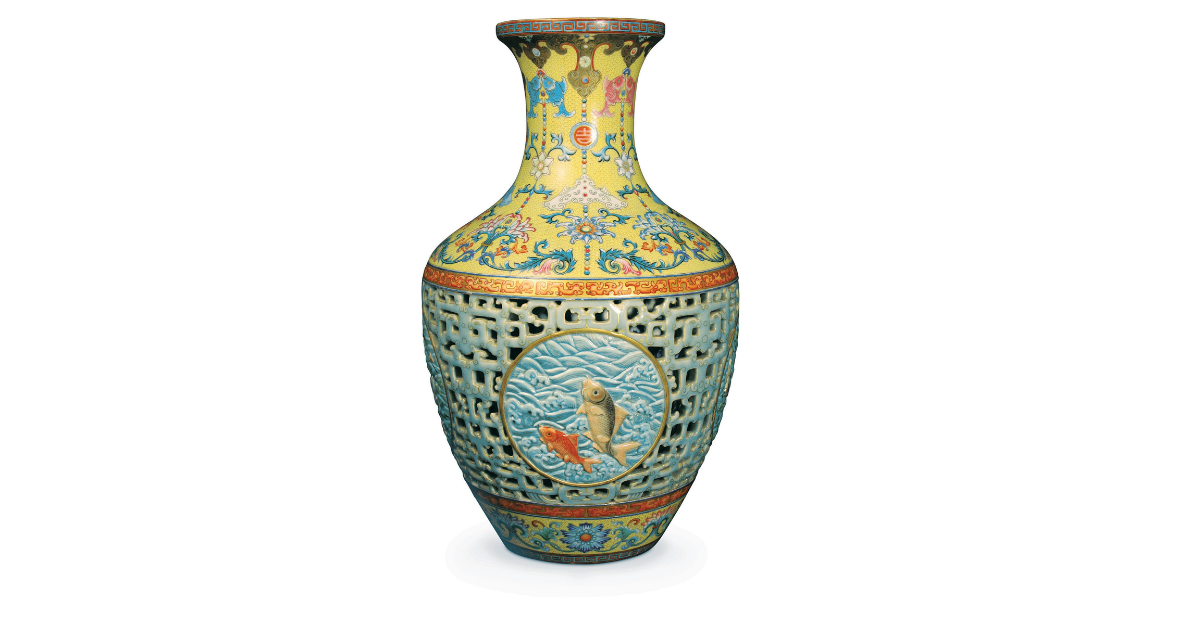
Pinner Qing Dynasty Vase, Qianlong Period c.1736–1795 · Source: Bainbridge’s Auction House, London
For decades it sat in a modest English home, presumed to be a pleasant replica worth around $1,000. Then a Bainbridge’s specialist noticed the four-character imperial seal on the base. The Pinner Vase — a golden enamel masterpiece depicting fish, flowers, and intricate landscapes — was suddenly reappraised at $1 million. That figure, too, proved a vast understatement — and the Pinner Vase would become the centerpiece of any list of the most expensive historical artifacts ever sold.
The image above shows every hallmark of authentic Qianlong imperial porcelain: the yellow famille rose ground, the extraordinary reticulated lattice body (the outer shell is painstakingly carved through to reveal the inner vessel beneath), and the circular medallion depicting two carp leaping through cresting waves — a symbol of imperial prosperity and abundance. These were crafted at the kilns of Jingdezhen, which served the Chinese imperial court for over a millennium. How this vase ended up on a suburban English shelf remains one of the great mysteries of the antiques world.
Scholars still debate how exactly it left China — perhaps carried out during the turbulent post-Qing decades — and surfaced decades later in a British home with no idea of its imperial pedigree.
“It was thought to be a nice replica. Then everything changed — the seal was authenticated, and the world’s most expensive antique emerged from a dusty shelf.”
At the November 2010 Bainbridge’s auction, a Chinese industrialist bid £43 million against fevered competition — a world record at the time. However, he controversially refused to pay the buyer’s premium, triggering a legal and reputational dispute that remains one of the most remarkable episodes in auction house history.
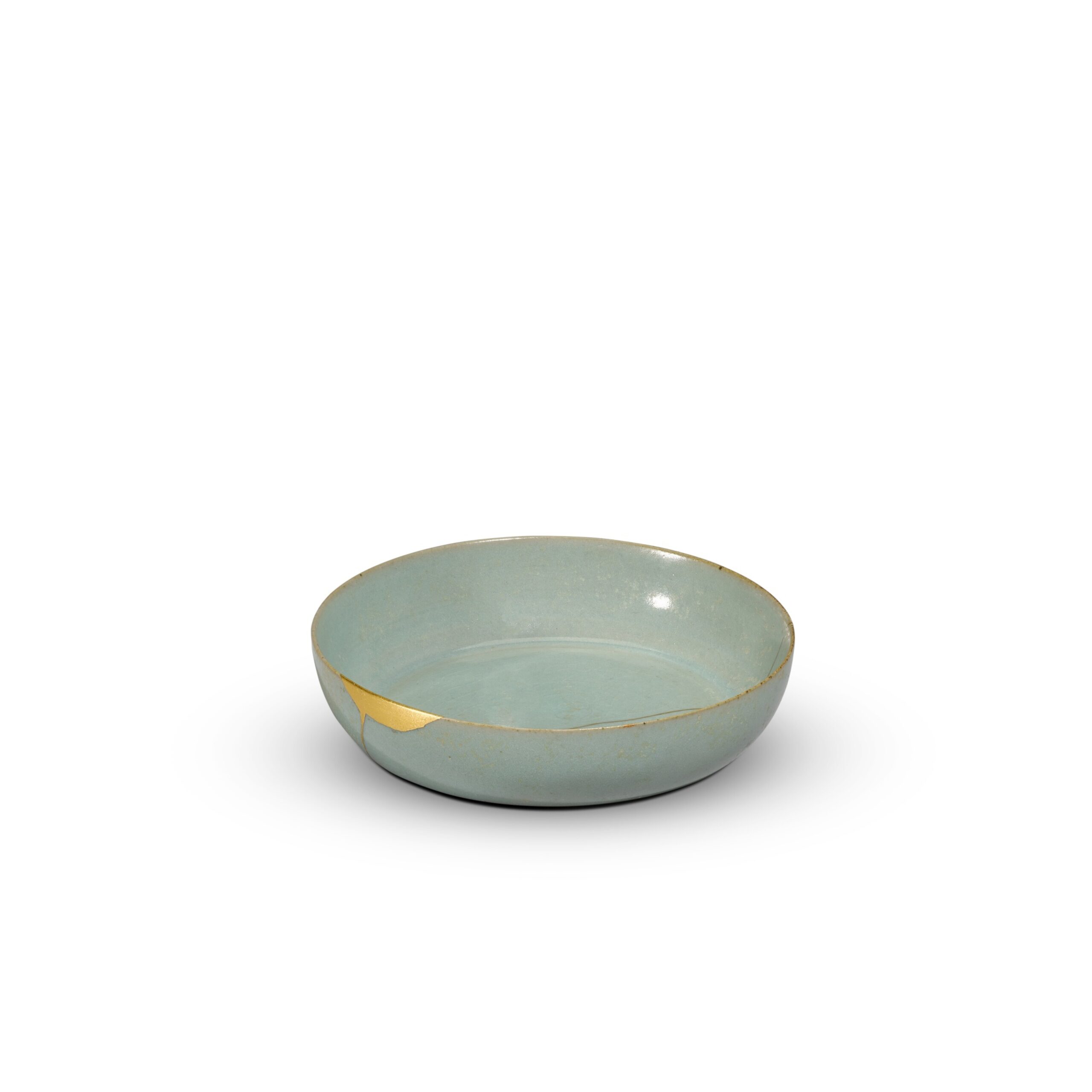
Ru Guanyao Brush Washer, Northern Song Dynasty c.960–1127 CE · Source: Sotheby’s Hong Kong
Of all Chinese ceramics, Ru ware is the most coveted. Produced for barely 20 years during the Northern Song Dynasty (960–1127 CE) exclusively for the imperial court, fewer than 90 authenticated Ru pieces are known to exist worldwide. The Palace Museum Beijing, the Victoria & Albert Museum in London, and the Percival David Foundation guard theirs like national treasures.
This bowl demonstrates exactly what makes Ru ware priceless: the pale sky-blue celadon glaze that Song Dynasty connoisseurs called “blue sky after rain,” and — visible on the lower rim — a gold kintsugi repair. Far from reducing value, this centuries-old gold restoration marks how carefully the bowl was preserved across generations. The fine hairline crackle across the glaze surface, called crab-claw, is considered the pinnacle of Chinese ceramic refinement.
It sold at Sotheby’s Hong Kong in October 2017 for HK$294.3 million (approximately $37.68 million USD), setting a world auction record for any Chinese ceramic at that time — a record that stood for several years.
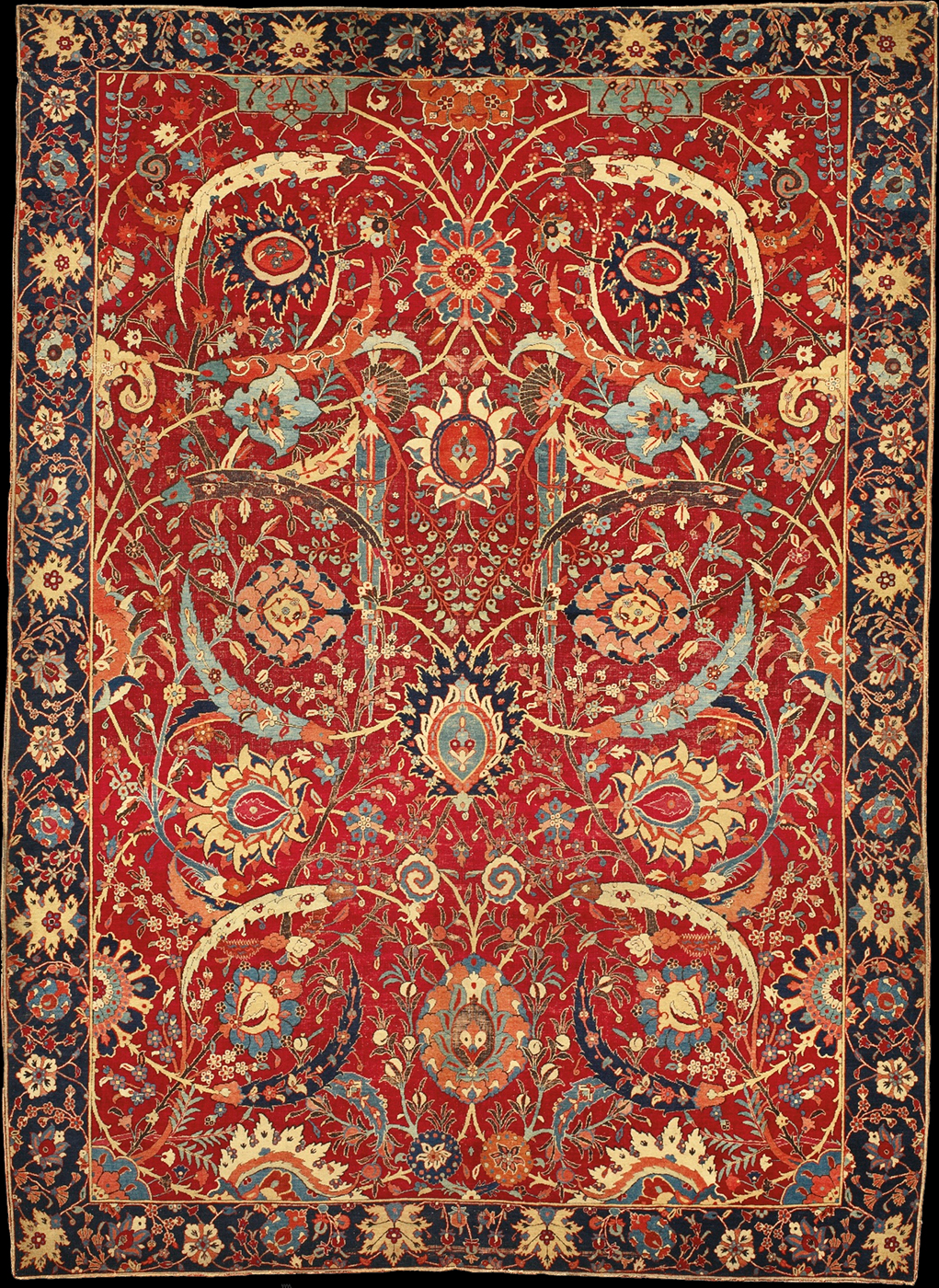
Clark Sickle-Leaf Carpet, Safavid Persia, 17th Century · Source: Sotheby’s New York / Corcoran Gallery
Woven in Safavid Persia in the 17th century, the Clark Sickle-Leaf Carpet is widely regarded as the finest surviving example of the “vase carpet” tradition — a weaving style so technically demanding that modern textile historians still debate how it was produced. No working example of the loom type required to create it has ever been identified.
Study the image: the deep crimson field, the swirling arabesque tendrils, the curving sickle-shaped leaves branching from central palmette medallions in teal and ivory. Each square inch of this carpet contains thousands of individually hand-tied knots. The palette — madder red, indigo, saffron, ivory — has held its extraordinary vibrancy for four centuries, a tribute to Safavid master dyers who sourced their pigments along the ancient Silk Road.
Up close, the dyes still feel alive — almost glowing under the raking light of a museum lamp, as though the weavers finished their work last season rather than four hundred years ago.
When it sold at Sotheby’s New York in June 2013 for $33.8 million, it shattered all previous records for any textile sold at auction by a considerable margin. The anonymous buyer has kept it from public view ever since.
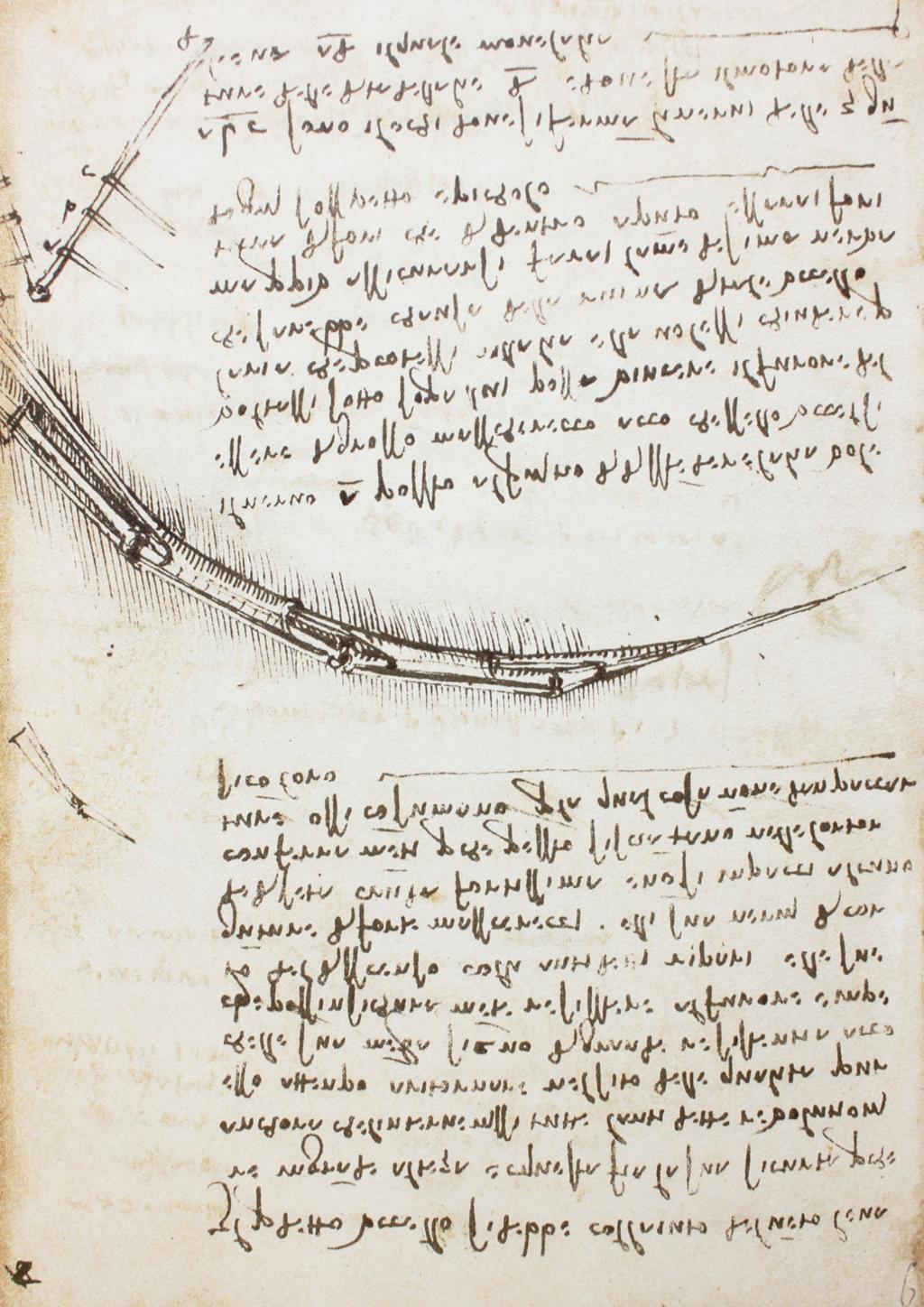
Codex Leicester, Leonardo da Vinci, c.1506–1510 — Mirror Script Page · Source: Christie’s New York
In November 1994, Bill Gates paid $30.8 million for the Codex Leicester — a 72-page scientific journal handwritten and illustrated by Leonardo da Vinci (1452–1519) between 1506 and 1510. Adjusted for inflation, that price exceeds $65 million in 2025 dollars, making it the most expensive manuscript ever sold at public auction.
The page shown above illustrates da Vinci’s famous mirror script — written right-to-left, legible only when held to a mirror. Leonardo was left-handed and found this entirely natural. Notice the mechanical sketches at the margins — engineering studies of structural frames and bridge components. The Codex contains his revolutionary observations on the movement of water, the luminosity of the Moon, fossil formation, and atmospheric optics. His notes on hydrodynamics anticipate Leonardo da Vinci’s scientific legacy by nearly 200 years.
“The Codex Leicester is arguably the most intellectually dense 72 pages ever committed to paper — a solitary mind rewriting the laws of nature.”
Gates scanned the entire manuscript and released it as a Windows 95 screensaver, making the world’s most expensive book also briefly one of the most widely seen documents in history.
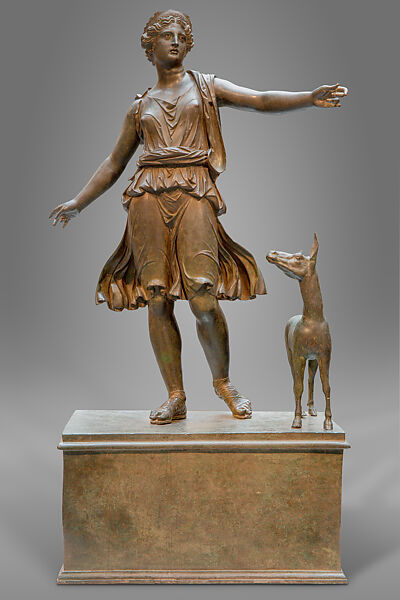
Artemis and the Stag, Roman Imperial Bronze, c.100–150 CE · Source: Sotheby’s New York
In the 1920s, construction workers excavating in Rome unearthed a massive bronze figure — a 2,000-year-old statue of Artemis, the Greek goddess of the hunt, striding alongside a stag. They had no idea what they had found. The statue spent decades in private hands, its true age entirely unappreciated until scholarly attention arrived decades later.
As shown above, the figure captures the canonical Artemis type: mid-stride, one arm outstretched in a commanding gesture, her deer companion beside her. The naturalistic billowing drapery, the confident posture, the intact animal companion — all hallmarks of high-quality Roman Imperial bronze casting (c. 100–150 CE). Standing over 7 feet tall in the original, it is a Roman copy of an earlier Greek original and is considered one of the finest large-scale Roman bronzes surviving outside a museum collection.
At Sotheby’s New York in 2007 it achieved $28.6 million, shattering the world record for a classical sculpture and prompting significant debate about international antiquities export ethics.
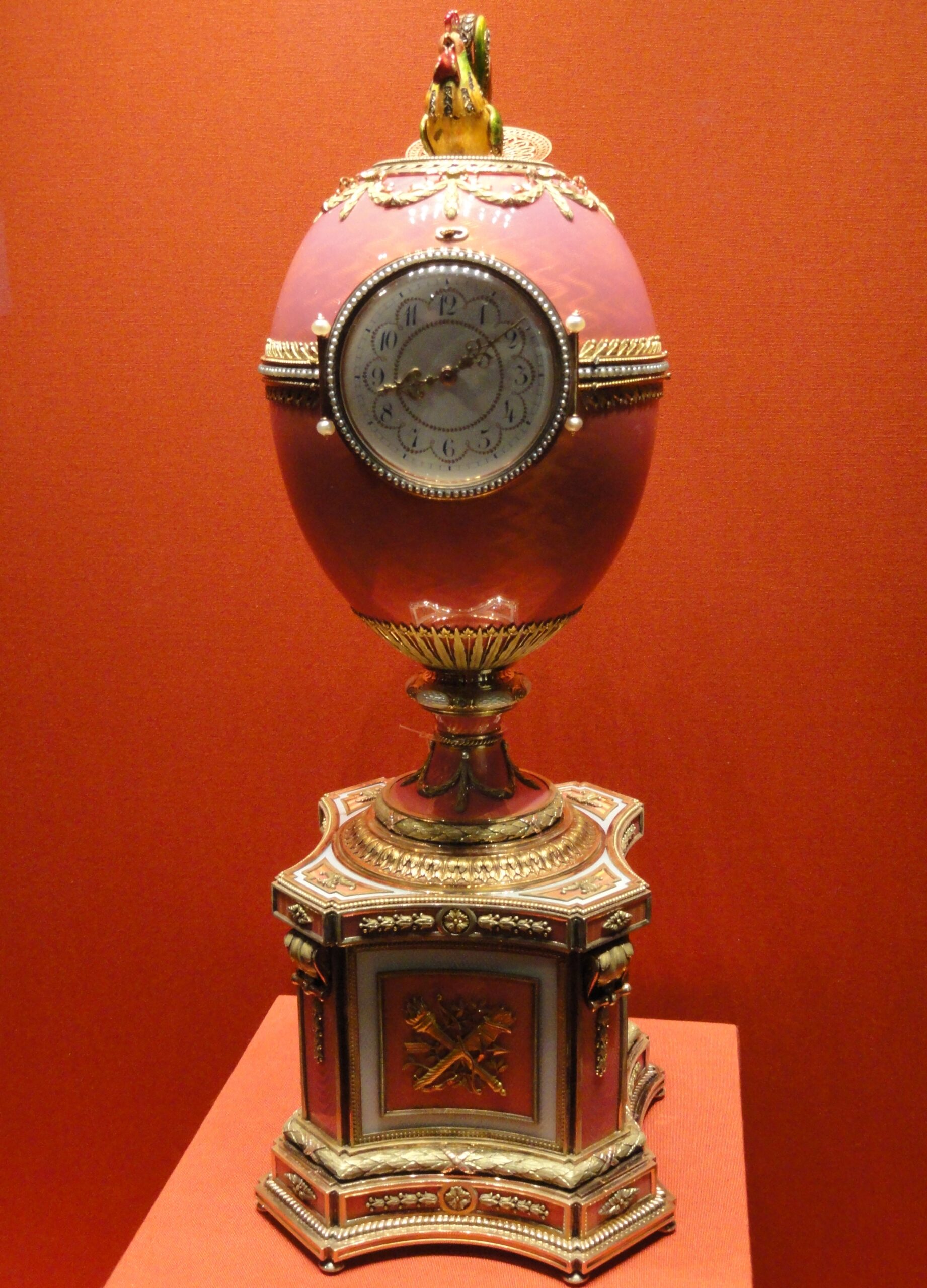
Rothschild Fabergé Egg, 1902 — Now Held at Fabergé Museum, Baden-Baden · Source: Wikimedia Commons / CC BY 2.0
Created in 1902 by the House of Fabergé for the Rothschild banking dynasty, this is a tour de force of miniature engineering. The image above shows the complete form: a deep red enamel egg with a clock face set into its body, mounted on an ornately gilded hexagonal pedestal. At the apex — a jeweled cockerel automaton that rises on the hour to crow and flap its wings. Over 1,000 individual components are hidden within this single object you could hold in two hands.
Unlike the famous Imperial Easter Eggs commissioned by the Russian Tsars — most scattered or destroyed after the 1917 Revolution — the Rothschild Egg remained in private hands for an entire century, largely unknown to scholars. Its discovery was treated as a major event in the Fabergé world.
When it sold at Christie’s London in 2007 for $18.5 million, it tripled the previous world auction record for any Fabergé work. It now resides permanently at the Fabergé Museum in Baden-Baden, Germany.
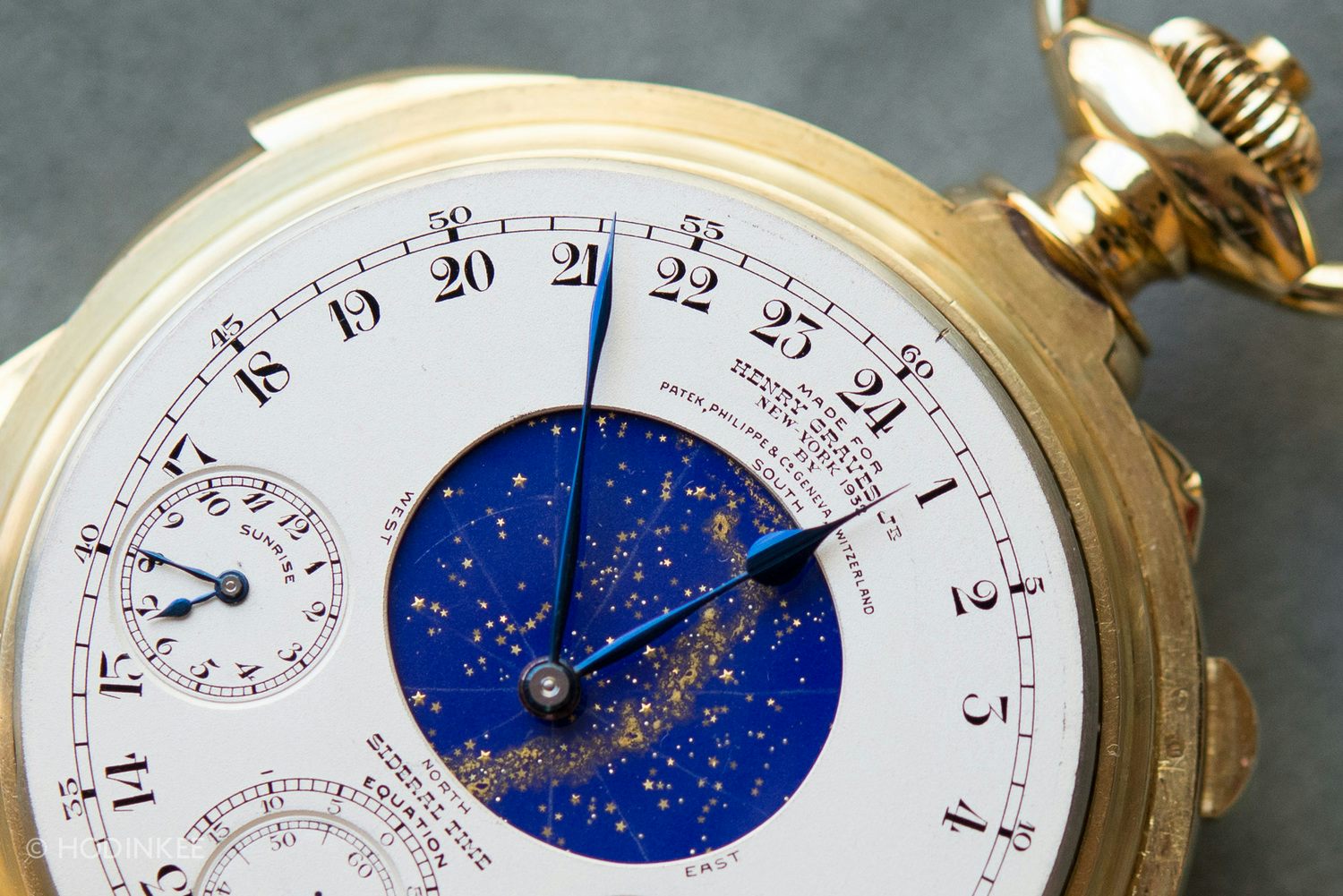
Patek Philippe Henry Graves Supercomplication Pocket Watch, Completed 1932 · Source: Sotheby’s Geneva
Commissioned in 1925 by American banker Henry Graves Jr. in a private horological rivalry with automobile magnate James Ward Packard, the Supercomplication was completed in 1932 after eight years of total effort — three years of design and five years of manufacture — every component crafted entirely by hand in Geneva.
The watch contains 24 separate complications: a perpetual calendar, Westminster Chime, minute repeater, sunrise and sunset times calibrated to the coordinates of Henry Graves’ Manhattan apartment on Fifth Avenue, a celestial chart of the night sky precisely as seen from that apartment, and accurate phases of the Moon among many others. At the moment of its completion, it was formally assessed as the most technically complex object ever manufactured by human hands. That record held for over 50 years.
Sold at Sotheby’s Geneva in November 2014 for CHF 23.2 million (approximately $24 million USD), it remains the most expensive pocket watch ever sold at public auction. The anonymous buyer has not exhibited it since.
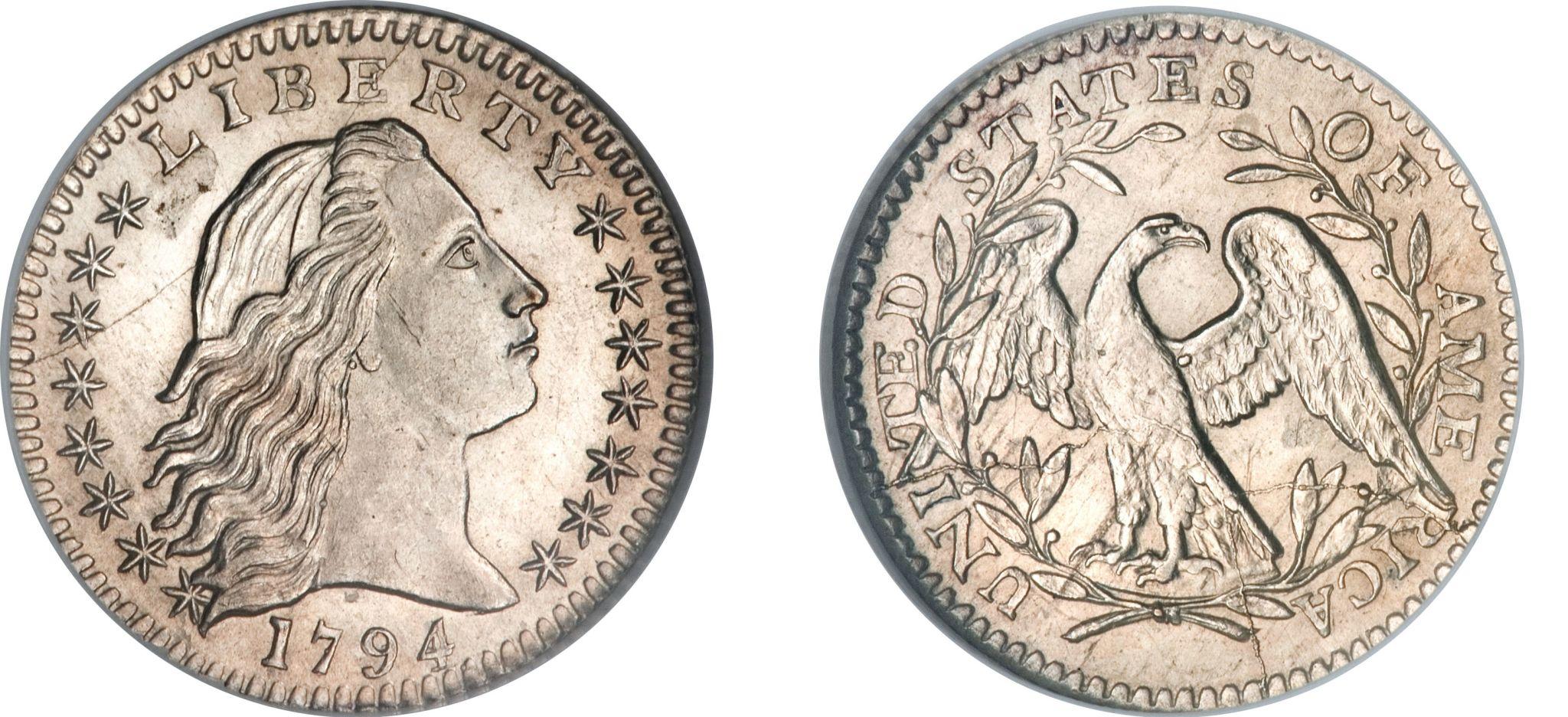
1794 Flowing Hair Silver Dollar — Obverse & Reverse, MS-66 Grade · Source: Stack’s Bowers Galleries
On October 15, 1794, the newly established United States Mint struck its first official silver dollars. Approximately 2,000 coins were produced that day, but fewer than 140 are known to have survived in any condition. In MS-66 grade (near-perfect, the finest possible), a single specimen exists in the world: the Goddard Coin.
Both sides are shown above. Left: Liberty with flowing unbound hair, ringed by 15 stars — one for each state of the young republic — dated 1794. Right: a spread American eagle with wings raised, clutching olive branches, encircled by “United States of America.” Together, these two faces form not merely a coin but the birth certificate of American currency — the first time the United States government produced a silver dollar. Its existence is the founding declaration of the American monetary system.
The Goddard family purchased this specimen in the 1880s for $1,000. At Stack’s Bowers Galleries in January 2013 it became the first coin in history to exceed $10 million at auction — a record that still stands over a decade later.
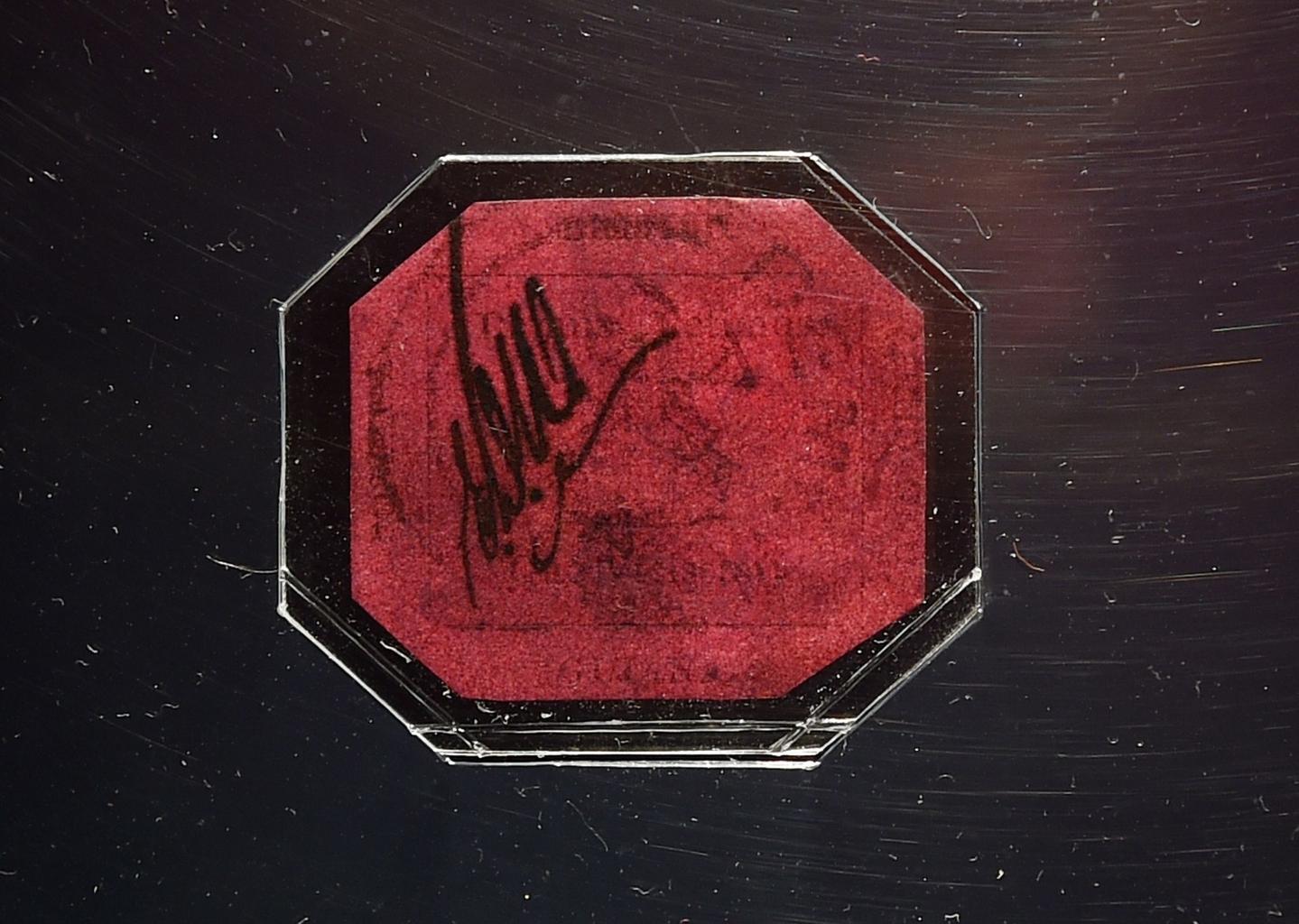
British Guiana 1856 One-Cent Magenta Stamp in Protective Case · Source: Sotheby’s New York
What you are looking at sold for $9.4 million. This scrap of magenta paper — originally worth one cent — is preserved inside a clear octagonal protective case and handled with the reverence usually reserved for sacred relics. By weight, this is the most valuable object per gram ever traded at public auction — an extreme case study in how rarity transforms the most expensive historical artifacts into something beyond ordinary valuation: worth more per gram than diamonds, platinum, or any rare earth element ever recorded.
In 1856, the British colony of Guiana (modern Guyana) ran short of its regular stamp supply from London. The local postmaster improvised: he printed a small emergency batch on a local newspaper press using a sailing ship design and the Latin motto “Damus Petimus Que Vicissim” (We give and we expect in return). Within weeks, normal supplies arrived from London. The improvised stamps were discarded — or so it seemed.
Not every priceless object is beautiful. Some are simply irreplaceable — and this faded scrap of magenta paper, smaller than a matchbox, is the most extreme example of that truth in the history of collecting.
“The British Guiana 1c Magenta is believed to be the only surviving example of its exact type in the world. A universe of one.”
In 1873, a twelve-year-old collector named Vernon Vaughan found it tucked inside a box of old family papers and sold it to a local dealer for six shillings. The stamp has changed hands six times since — each time setting a new world record for rare stamps and philately.
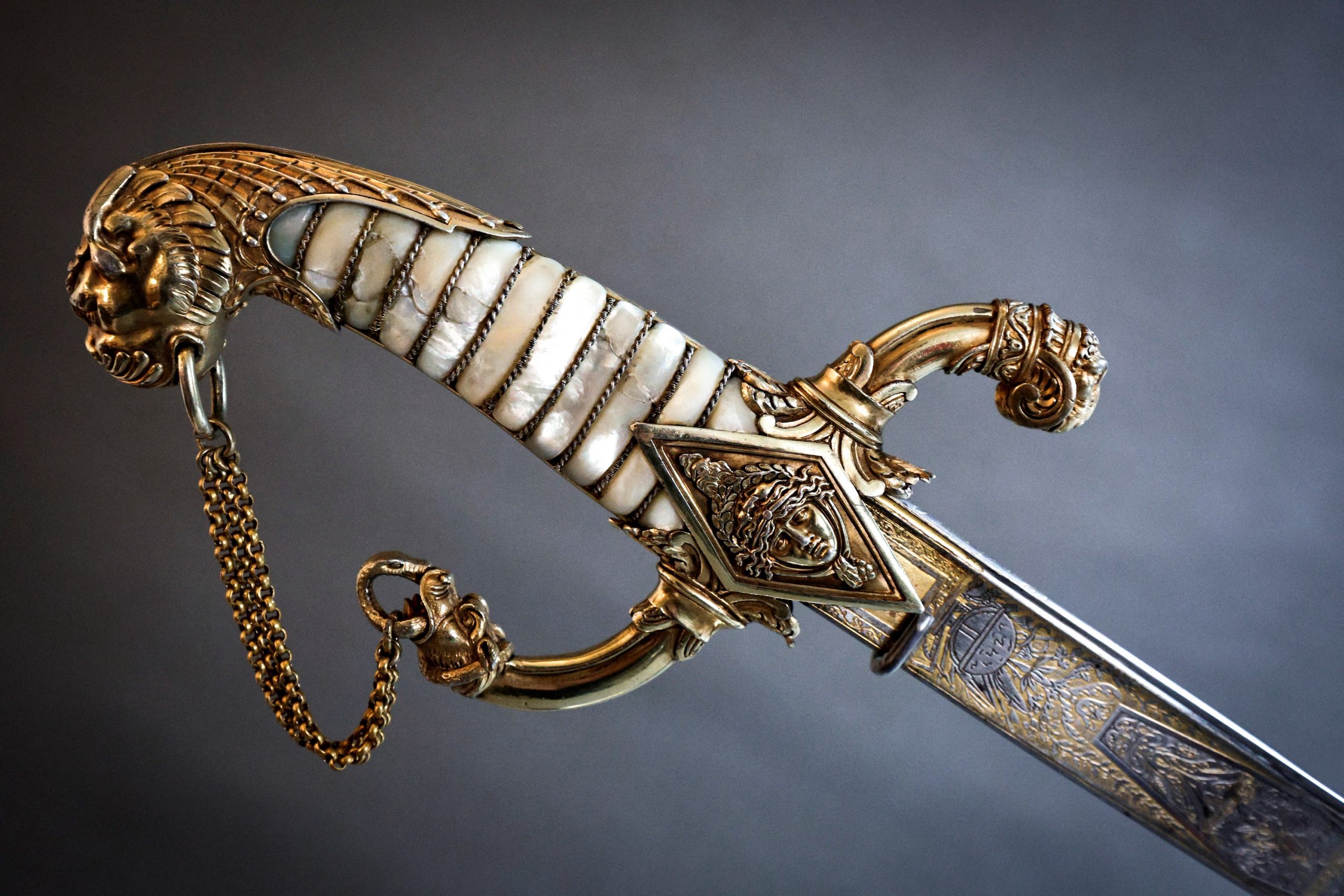
Napoleon’s Marengo Sword — Detail of Gold Hilt, c.1800 · Source: Getty Images / Fonds des Musées Nationaux
This is the sword Napoléon Bonaparte carried at the Battle of Marengo on June 14, 1800 — the dramatic counterattack that shattered Austrian control of northern Italy and secured Napoleon’s grip on France at its most politically vulnerable moment. It also accompanied him during the Egyptian Campaign of 1798–1799.
The close-up above reveals extraordinary Parisian craft: the grip wrapped in alternating bands of mother-of-pearl and gold wire; the pommel cast as a gold lion’s head — symbol of imperial command; the guard bearing a carved portrait medallion in relief; the blade beginning below with fine engraved military decoration. Napoleon was exacting about his personal weapons — this sword was custom-made to fit his small hands. The wear on the grip is real. This sword saw battle.
It sold in 2007 for €4.8 million (~$6.4 million USD) to France’s Fonds des Musées Nationaux, ensuring it remained within French national heritage as one of the most significant authenticated Napoleonic battlefield artifacts anywhere in the world.
The most expensive historical artifacts tend to emerge from imperial courts, revolutionary upheavals, or pivotal moments in global history — circumstances that guarantee uniqueness and sever the supply chain forever.
All prices verified against primary auction house records. Inflation adjustments use US CPI data to 2025.
| # | Artifact | Era / Origin | Auction House | Year | Sale Price | 2025 Value (est.) | Rarity Note |
|---|---|---|---|---|---|---|---|
| 01 | Pinner Qing Dynasty Vase | c.1736–95 China | Bainbridge’s, London | 2010 | $80.2 M | ~$115 M | 1 confirmed specimen |
| 02 | Ru Guanyao Brush Washer | 960–1127 CE China | Sotheby’s Hong Kong | 2017 | $37.68 M | ~$46 M | <90 Ru pieces exist |
| 03 | Clark Sickle-Leaf Carpet | 17th C. Persia | Sotheby’s New York | 2013 | $33.8 M | ~$45 M | Textile world record |
| 04 | Codex Leicester (da Vinci) | 1506–10 Italy | Christie’s New York | 1994 | $30.8 M | ~$65 M | ~30 da Vinci notebooks exist |
| 05 | Artemis and the Stag | 100–150 CE Rome | Sotheby’s New York | 2007 | $28.6 M | ~$42 M | Exceptionally preserved |
| 06 | Rothschild Fabergé Egg | 1902 Russia | Christie’s London | 2007 | $18.5 M | ~$27 M | Only Rothschild egg |
| 07 | Patek Philippe Supercomplication | 1932 Switzerland | Sotheby’s Geneva | 2014 | $24 M | ~$31 M | Unique commission |
| 08 | 1794 Flowing Hair Dollar | 1794 USA | Stack’s Bowers | 2013 | $10.0 M | ~$14 M | Only MS-66 specimen |
| 09 | British Guiana 1c Magenta | 1856 British Guiana | Sotheby’s New York | 2014 | $9.4 M | ~$12 M | Unique worldwide |
| 10 | Napoleon’s Marengo Sword | c.1798–1800 France | Fonds Musées Nat. | 2007 | $6.4 M | ~$9.5 M | Verified battlefield use |
Answers to the most searched questions about the most expensive historical artifacts ever brought to public auction.
Transparency in sourcing and selection criteria
All ten artifacts in this article were selected based on independently verified hammer prices or buyer’s totals reported in primary auction house records. We do not include unverified reports, private treaty sales where prices were not publicly confirmed, or disputed figures.
Our ranking focuses strictly on verified public sales of the most expensive historical artifacts, excluding private treaty transactions where final prices were never officially confirmed.
Each artifact’s historical context, provenance, and significance was cross-referenced against museum publications, academic catalogue essays, and where available, auction house lot notes. Inflation adjustments use the US Bureau of Labor Statistics CPI calculator.
© 2025 The Historical Insights · All sale prices are verified hammer prices or buyer’s totals from primary auction records. Inflation-adjusted values are approximate estimates using US CPI data. This article is for educational and research purposes. These most expensive historical artifacts reveal how cultural significance, absolute rarity, and provenance shape the global heritage market.