Physical Address
304 North Cardinal St.
Dorchester Center, MA 02124
Physical Address
304 North Cardinal St.
Dorchester Center, MA 02124

 |
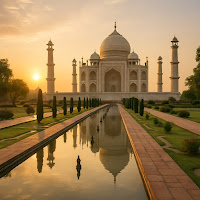
| The Taj Mahal glows in golden light, mirrored in its tranquil reflecting pool. |
The tranquillity of the city of Agra, along the banks of the Yamuna River, is broken only by the one monument that seems to speak with feeling. The Taj Mahal- called the most perfect example of white marble architecture in the world- is more than an architectural wonder. It is a postcard from history, a love story carved and built from stone. Behind the perfection of the building is the sorrow of an emperor, the loyalty of a husband, and the legacy of a dynasty.
The Mughal Empire was established in 1526 by Babur. As one of the significant dynasties on the Indian subcontinent, the Mughal Empire was not going to outdo itself at a time of cultural and architectural mutedness, like it did in the epochal 1700s. The Mughal Empire was clearly important culturally because of its wealth and power, while the judges and Jahangir were culturally and politically at an unprecedented height, with a very rich court under the fifth Mughal Emperor, Shah Jahan.
Shah Jahan eloped with his wife, Arjumand Banu Begum or Mumtaz Mahal, in 1612 before becoming a successful Mughal Emperor. In 1612, a year after Shah Jahan and Mumtaz got married, the joy of him and the Mughal Empire was in deep mourning with the death of Mumtaz while giving birth to their fourteenth child. In his mourning vow, he was going to have a monument built for Mumtaz, something unique, and what he considered that love and mourning came together. In 1632, the Taj Mahal, as we now know it, began construction.
📜 Timelines Box: Important Dates
 |
| Shah Jahan oversees artisans shaping the Taj Mahal. |
 |
| Mughal artisans at work near the Taj Mahal. |
While the Taj Mahal was under construction, Mughal court life continued to thrive. Craftsmen worked with marble and stone inlays and inscriptions, while other artisans produced textiles, miniatures, and metalwork. Nearby markets carried silks, spices, and gems, which were all used by the laborers and artisans working on the project.
 |
| Shah Jahan with the Taj Mahal behind him. |
What other stories does history whisper to us through its monuments? Perhaps the next time you see a grand structure, you’ll ask: Who built this? And why?
Discover other mind-blowing moments from history you probably never learned in school.
What other stories does history whisper to us through its monuments? Perhaps the next time you see a grand building, you’ll find yourself asking: Who built this? And Why?
About the Author:
I’m Ali Mujtuba Zaidi, a passionate history enthusiast who enjoys exploring how the past connects to our present. Through this blog, I share my thoughts and research on ancient civilizations, lost empires, and the lessons history teaches us today.