Physical Address
304 North Cardinal St.
Dorchester Center, MA 02124
Physical Address
304 North Cardinal St.
Dorchester Center, MA 02124
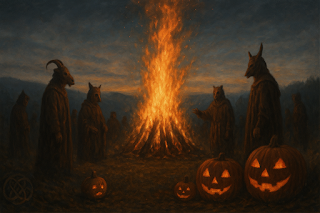
Every October, when fake cobwebs take over front yards and plastic skeletons hang from porches, we call it Halloween. But here’s the twist — the festival we treat as a night of costumes and candy actually started as a sacred ritual thousands of years ago. Long before kids shouted “trick or treat,” ancient Celts were lighting bonfires to keep spirits away. What we celebrate today is basically an ancient survival ritual in disguise.
Halloween isn’t a modern invention, it’s a cultural echo — a mix of ancient fear, church politics, immigrant traditions, and modern consumerism, all blended into one wild night. Let’s pull the mask off and see what it really is.
|
| Where Samhain’s fire met the shadow, Halloween was born. |
Halloween started with a Celtic festival called Samhain (pronounced “sow-in”). Around 2,000 years ago, people in what’s now Ireland, Scotland, and parts of France marked this as the end of harvest and the beginning of winter — basically, their version of New Year’s Eve.
But Samhain wasn’t all feasting and fires. The Celts believed that on this night, the boundary between the living and the dead blurred. Spirits could cross over, good or bad. So people lit huge bonfires, offered crops and animals to their gods, and wore costumes made of animal skins to confuse or scare away ghosts.
If that sounds a little spooky, it’s because it was. The entire purpose of Samhain was to stay safe from whatever might slip through from the other side. You can still feel that energy in how we decorate our homes with skulls and monsters today.
You can read more about how ancient societies used fear as power in Before TikTok and Twitter: How Empires Controlled Information — it’s wild how much old rituals mirror modern manipulation.
Fast forward a few centuries. As Christianity spread through Europe, the Church had a problem — people weren’t giving up their old pagan traditions. So instead of banning Samhain, the Church rebranded it. Around the 9th century, All Saints’ Day (or All Hallows’) was set on November 1st to honor saints and martyrs. The night before became All Hallows’ Eve, which eventually slurred into “Halloween.”
That was clever strategy, not coincidence. The Church often blended old customs with new beliefs to make conversion easier. And even after centuries of Christian rule, people kept lighting fires and dressing up to keep spirits away — just with new religious labels.
It’s a reminder that faith and folklore were never enemies. They just evolved together, reshaping how people dealt with fear, death, and change.
By the Middle Ages, Halloween was a mix of religion, superstition, and folklore. People went door-to-door performing small plays or songs — a practice called “souling.” In exchange, they received food or money for prayers to help souls move from purgatory. Sounds familiar, right? That’s the ancestor of trick-or-treating.
During this era, people believed witches could summon evil spirits, black cats were bad luck, and the veil between worlds was thinnest on Halloween night. Even the idea of carving pumpkins has roots here — only back then, they used turnips instead of pumpkins. Inside the flickering faces, people saw protection from wandering spirits.
You can see a similar pattern in how myths and real history blur in Secrets and Untold Stories of the Real Caribbean Pirates Revealed — legends often start as survival tactics before they become entertainment.
When Irish immigrants came to the United States in the 1800s, they brought their Halloween customs with them. America, being a melting pot of traditions, gave it a whole new identity.
The Puritans originally hated Halloween because of its pagan roots, but by the late 19th century, the festival was slowly becoming part of American life. Immigrants introduced trick-or-treating, jack-o’-lanterns, and costumes to a culture that loved pageantry and fun.
By the 1920s and 30s, Halloween turned more community-based. Parades, neighborhood parties, and pranks became the norm. Newspapers encouraged families to celebrate together instead of letting kids cause chaos — which is kind of how Halloween turned from spooky to sweet.
Today’s Halloween is less about the dead and more about decoration, costumes, and candy. But that doesn’t mean the ancient meaning is gone — it’s just buried under layers of plastic and sugar.
By the mid-20th century, big brands saw profit potential. Candy companies, movie studios, and costume makers jumped in. Trick-or-treating exploded after World War II, and TV shows made it mainstream. Halloween became a billion-dollar industry — but its soul, the idea of confronting fear, never disappeared.
If you dig into how commercial influence shapes traditions, you’ll find similar insights in Before TikTok and Twitter: How Empires Controlled Information — it’s the same playbook, just different era.
What’s fascinating is how different countries took Halloween and gave it their own flavor.
Mexico’s Día de los Muertos (Day of the Dead) celebrates loved ones with food and music, not fear.
Japan’s Obon Festival honors ancestors with lanterns and dances.
The Philippines’ Pangangaluluwa has people singing for souls, much like medieval “souling.”
Halloween isn’t global because of Hollywood — it’s global because every culture has some way of facing death and the unknown. The spooky costumes are just a universal language for something deeply human.
You can find similar cross-cultural echoes in Ancient Civilizations Explained — civilizations might fade, but their beliefs sneak into modern life in surprising ways.
So why do we still love being scared? Because fear, in small doses, feels good. It’s like our brain’s way of testing danger safely. Haunted houses, horror movies, scary stories — they all play with the same instinct the Celts had at Samhain: facing the dark without getting lost in it.
Psychologists say fear creates excitement, and when you survive the scare, your brain rewards you with dopamine. So yeah, Halloween is basically ancient therapy.
Strip away the costumes and candy, and Halloween still hits the same emotional note it did 2,000 years ago — it’s a night about transformation. A night when we pretend to be someone (or something) else. A moment when death isn’t scary but playful.
It’s not about ghosts, really. It’s about control. Turning fear into something fun. Every mask, pumpkin, and fake ghost is our way of saying: “We see you, darkness, but we’re not afraid.”
Q: Is Halloween originally pagan or Christian?
A: Both, in a way. It started as a Celtic pagan festival (Samhain) and was later Christianized as All Hallows’ Eve.
Q: Why do we carve pumpkins?
A: It comes from an Irish legend about “Stingy Jack.” People carved faces into turnips to scare away his spirit, and when they reached America, pumpkins took over.
Q: When did trick-or-treating start?
A: It traces back to medieval “souling” and “guising.” Kids went door-to-door for food or prayers long before candy.
Q: Why do we love scary movies around Halloween?
A: Fear releases adrenaline and dopamine, making it thrilling. It’s the same ancient rush people felt during Samhain fires.
Q: Do other cultures celebrate something similar?
A: Yes. Day of the Dead (Mexico), Obon (Japan), Hungry Ghost Festival (China), and Pangangaluluwa (Philippines) all honor the dead in their own ways.
Halloween keeps changing, but it’s never really left its roots. Whether you’re lighting a candle, watching a horror film, or just sneaking another chocolate, you’re part of a tradition that began when people looked into the dark and decided to dance with it instead of hide.
And maybe that’s why it still feels timeless.