Physical Address
304 North Cardinal St.
Dorchester Center, MA 02124
Physical Address
304 North Cardinal St.
Dorchester Center, MA 02124

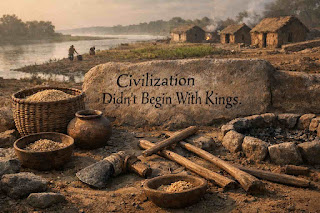
When people think about the beginning of civilization, they usually imagine crowns, armies, pyramids, or great rulers.
That picture feels right. It’s dramatic. And it’s mostly wrong.
Human civilization did not begin with empires or monuments. Those were outcomes, not starting points. Civilization began much earlier, when humans created systems that allowed them to plan beyond the present moment.
.jpg "How human civilization began through agriculture, permanent settlement, and shared systems rather than kings or empires") |
| Civilization didn’t begin with crowns or armies. It began when humans learned to stay, store, and plan. |
It began when survival stopped being the only concern, and the future started to matter.
This shift explains why what survives becomes history. The systems that endured were recorded, protected, and remembered. Everything else quietly disappeared.
This article explains how life worked before civilization, why agriculture changed human behavior, how settlements became cities, and how early societies built structures that still shape the modern world.
For most of human existence, civilization did not exist.
Early humans lived as hunter-gatherers. They moved with seasons, followed animals, and relied on deep environmental knowledge rather than permanent structures.
Pre-civilized societies generally shared these traits:
Because food was unpredictable, surplus could not be stored. Without surplus, long-term planning was impossible. This is why complex organization did not emerge earlier, a pattern also explored in studies of early human societies.
Everything changed after the last Ice Age.
As climates stabilized, humans began observing plant cycles, saving seeds, and staying near reliable food sources. Over generations, this led to the domestication of crops like wheat, barley, rice, and millet, along with animals such as sheep, goats, and cattle.
The most important result of agriculture was not farming itself, but surplus.
This process, known as the Neolithic Revolution, made permanent settlement possible and laid the groundwork for civilization, a transformation closely linked to how early societies shaped civilization.
Farming tied people to land.
Crops required care, protection, and time. Homes formed near rivers and fertile soil. With permanence came challenges humans had never faced before.
Shared rules, customs, and leadership roles developed to manage these pressures. This was the true beginning of organized society.
Reliable food allowed populations to grow.
As communities expanded, not everyone needed to farm. People began to specialize.
Specialization increased efficiency and innovation, but it also introduced hierarchy. Control over resources and authority became uneven, a pattern repeated throughout historical empires.
When settlements reached a critical size, villages became cities.
Cities required systems small communities never needed.
Urban life also brought disease, waste, and unrest. Legal systems and bureaucracy emerged as solutions to problems created by scale.
Mesopotamia, between the Tigris and Euphrates rivers, offers the earliest clear example of full civilization.
Unpredictable flooding forced cooperation and centralized planning.
Key developments included:
This region shows how environmental pressure can accelerate organization, a theme explored in discussions of Mesopotamian civilization.
Writing changed civilization permanently.
It allowed societies to record laws, track resources, and preserve authority across generations.
But writing also decided whose voices lasted. History became a record of power more than a record of everyday life, reinforcing ideas explored in how we misunderstand the past.
Not all civilizations followed the same path.
Egypt thrived on predictable Nile flooding and centralized authority. The Indus Valley shows advanced urban planning with little evidence of kings. Early China linked political power to moral behavior through the Mandate of Heaven.
Geography shaped governance.
Civilizations did not develop in isolation.
Trade spread crops, tools, and ideas. Competition for land and resources encouraged organized warfare. Military power became closely tied to political authority.
Civilizations rarely collapsed suddenly.
Decline usually followed familiar patterns:
Collapse often unfolded slowly, unnoticed by those living through it.
Civilization is not inevitable.
It is a system built on cooperation, surplus, authority, and long-term planning. It enabled extraordinary progress, but it also created inequality and fragility.
Modern societies still operate inside structures first built thousands of years ago. We are not as distant from the origins of civilization as we like to believe.
ANS: Human civilization began around 10,000 to 12,000 years ago during the Neolithic period, when humans adopted agriculture and started living in permanent settlements.
ANS: The transition from hunting and gathering to agriculture and organized food production marked the true beginning of civilization.
ANS: Agriculture created food surplus, which allowed population growth, permanent communities, and the development of specialized social roles.
ANS: Hunter-gatherer societies were mobile and focused on survival, while civilizations were settled, organized, and planned for long-term stability.
ANS: Key features include permanent settlements, surplus food, social hierarchy, governance systems, and record keeping.
ANS: The earliest known civilization developed in Mesopotamia, between the Tigris and Euphrates rivers.
ANS: No. Civilizations developed differently depending on geography, climate, and available resources.
ANS: Writing allowed societies to record laws, manage resources, preserve authority, and transmit knowledge across generations.
ANS: Not equally. Civilization increased stability and innovation but also introduced inequality and social division.
ANS: Most declined due to environmental stress, resource depletion, inequality, and an inability to adapt to changing conditions.