Physical Address
304 North Cardinal St.
Dorchester Center, MA 02124
Physical Address
304 North Cardinal St.
Dorchester Center, MA 02124

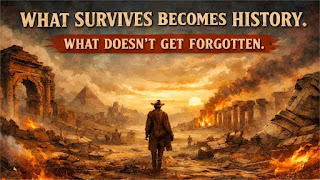
We like to believe history remembers what mattered most.
The great leaders. The decisive wars. The ideas that shaped the world.
In reality, history remembers what survived.
What we call “the past” is not a complete record of human experience. It is a collection of fragments that escaped fire, decay, censorship, neglect, and time. Entire worlds disappeared not because they lacked importance, but because survival was never guaranteed.
This is not a flaw in history. It is its nature.
.jpg "What Survives Becomes History: A Visual Reflection on Lost Civilizations and Forgotten Knowledge") |
| History doesn’t remember everything. It only remembers what managed to survive. |
For most of human existence, people did not record their lives with permanence in mind. Knowledge was passed through memory, ritual, craft, and conversation. Writing, when it existed, relied on fragile materials.
Whether something survived depended on conditions no one could control.
This explains why some eras appear richly documented while others feel silent. That silence often reflects destruction rather than absence, something clearly visible in Europe’s lost historical records, where entire archives vanished in a single event.
History does not reward importance. It rewards endurance.
Preservation has never been neutral. Those with authority controlled what was written, copied, archived, and taught.
Victors recorded victories. States documented administration. Religious institutions preserved belief. Everyday lives rarely made the cut.
Once these selective narratives entered education systems, they hardened into “facts,” even when later evidence contradicted them, as shown in cases where accepted history was overturned.
What survived often reflected authority, not accuracy.
Many societies relied on oral tradition, communal memory, and skilled practice rather than written texts. These systems worked well as long as continuity survived.
When disruption arrived, knowledge collapsed.
The absence of written evidence does not imply a lack of complexity. Archaeology continues to challenge that assumption, particularly in civilizations once dismissed as primitive.
Silence in the historical record is often a sign of loss, not simplicity.
Another misconception created by survival bias is the idea of steady progress. Technologies, skills, and systems were often lost and rediscovered.
Later societies sometimes lacked knowledge that earlier ones possessed.
Examples of this pattern appear in forgotten ancient technologies, where innovation moved sideways or backward rather than forward.
History is not a ladder. It is a landscape.
History is changing today not because historians are speculating more, but because evidence is becoming visible.
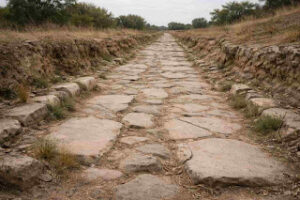
Hidden cities, road systems, and agricultural networks are being revealed beneath forests and farmland.
Genetic evidence has uncovered forgotten migrations, population mixing, and the role of disease in societal collapse.
Many of these findings align with recent discoveries reshaping human history.
Organizations such as the Smithsonian Institution and National Geographic regularly report on how these tools are revising long-held assumptions.
Accepting survival bias changes how we interpret both past and present.
This lens also reshapes modern interpretations, including those found in reassessments of World War One.
History becomes less comforting, but more honest.
1. Why does so much history disappear over time?
Answer: Because preservation depends on fragile conditions.
Most records were lost due to war, decay, climate, neglect, or political change, not because they lacked importance.
2. Does history record the most important events?
Answer: Not always.
History records what survived, which often reflects chance and power rather than true significance.
3. Were ancient societies careless about recording their past?
Answer: No.
Many societies used oral traditions, rituals, and materials that simply did not survive long-term.
4. Is written history more reliable than oral history?
Answer: Not necessarily.
Written records often reflect elite perspectives, while oral history preserved community experiences and lived reality.
5. Why are ordinary people missing from historical records?
Answer: Because elites controlled documentation.
Rulers, institutions, and victors decided what was written, copied, and preserved.
6. Does the absence of evidence mean a civilization was simple?
Answer: No.
Lack of records usually indicates loss, not a lack of intelligence, innovation, or complexity.
7. Was historical progress always forward-moving?
Answer: No.
Many technologies, skills, and systems were lost and later rediscovered, sometimes centuries later.
8. Can modern technology recover lost history?
Answer: Partially.
Archaeology, satellite imaging, and ancient DNA can reveal fragments, but never the full picture.
9. Does this mean history is unreliable?
Answer: No.
History is incomplete, not unreliable. It improves as new evidence challenges old assumptions.
10. Will our understanding of history continue to change?
Answer: Yes.
As long as new evidence emerges, historical narratives will continue to evolve.
.jpg)