Print Media and Public Opinion
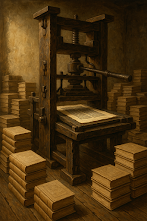
The emergence of print culture was significant for public opinion. Before the printing press, there was a slow spread of information, especially when compared to the distance newspapers and pamphlets could spread.
Pamphlets were especially powerful during the American and French Revolutions, helping to shape public opinion and ignite revolutionary ideas.
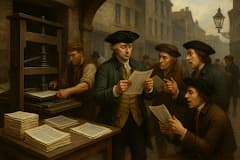 |
| Citizens gather to read printed news. |
Print has exponentially increased the reach of the subject matter, allowing citizens to engage in political dialogues, question social standards, and share their opinions with the public.
Print culture greatly aided in spreading ideas and influenced public opinion, especially during significant historical events.
In the 18th century, pamphlets and newspapers proved powerful for public opinion and spreading revolutionary ideas during the American and French Revolutions that shaped the course of history.
Print culture was able to make citizens more politically aware and to entertain debate on governance and society. While the printing press greatly accelerated the dissemination of information more widely, it also allowed a new opportunity for individuals to express their opinions publicly.
A change in the distribution of opinions and information changed discourse politically, which created and contributed to new political movements, including the shaping of modern democracy.
The Birth of New Social Groups
Print culture’s influence was not simply regarding literacy and education – it had a societal impact as well. Social roles were defined by wealth, birth, or land claim before printing.
But in the wake of wider accessibility to printed material, numerous roles emerged that helped define social attitudes. Writers emerged as figures of influence and culture, readers as public thinkers and debaters, publishers emerged as curators of ideas, and intellectuals emerged as engaged public theorists.
The emergence of these roles and functions within society helped create a new class of thinkers who were not tied to an aristocratic lineage, but to their own knowledge, creativity, and communicative efforts.
Writers gained the ability to influence broad audiences and engage in public discussions. Publishers gained the ability to curate ideas and distribute them.
Readers were specific audiences who were no longer exclusive to elite groups; they were groups of people from across society who wanted to learn and understand the world.
These fundamental social contrasts made society more dynamic and fluid, with ideas and intellectual ability becoming as valuable, if not more, than wealth and privilege.
Print culture enabled these new social groups to flourish, and they became agents in the cultural, social, and political revolutions.
Print Culture and Political Change
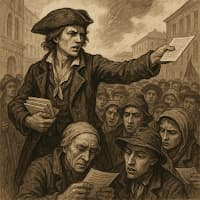 |
A leader spreads messages
to the people. |
The role of print in political change cannot be exaggerated. Print’s capacity to communicate political thoughts rapidly and extensively allowed it to become a borrowed technology for political movements, such as political revolutions.
At certain historical times of social and political change, printed matter, especially pamphlets, books, and newspapers, led to the organizing and mobilization of large numbers of the population.
Printed matter became the agency that propelled revolutionary thoughts to deliberate possibilities of political change. Printed pamphlets and books helped to associate ideas of revolution with the American and French Revolutions, respectively.
Print as a medium and as an idea then became associated with forms of democracy. Print mediated popular debate, political participation, and collective knowledge.
But the power of print also had the power of threat over the institutions of government. Consequently, censorship became a common response to express power over dissenting ideas. Nonetheless, the power of print remained elusive, and the print culture persisted in offering possibilities for political and social change that fashioned our modern world.
The Lasting Legacy of Print Culture
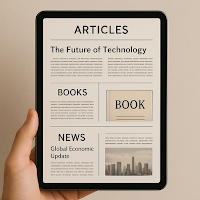 |
Online access to books,
news, and articles. |
The printing press has drastically changed the course of people’s lives from the moment it was invented.
Even in the age of immediacy, that is the internet, print still has an ongoing impact on human communication, even if we lack an understanding or recognition of it.
As we print and share through social media platforms, the connections to print culture and print are profound. The impact of the printing press created a pathway of knowledge that led to the first wide-scale education efforts, public opinion, and democratic principles.
The emerging print culture of the Renaissance allowed people to critique, think, speak, and question in ways that previously were simply impossible in a predominantly oral culture.
The promotion of printed text spurred continual revolutions, and intellectual and social movements.
Nowhere in technological evolution has the pervasive impact of the printing press been cast away from value systems and principles. It expanded the dissemination of free thoughts, ideas, and educational structures that compel democratic participation. Ancient and modern methods of spreading.
.jpg "Public Reading at a Historic Printing Stall.")
.jpg "Revolutionary Speech and Paper Distribution.")