Physical Address
304 North Cardinal St.
Dorchester Center, MA 02124
Physical Address
304 North Cardinal St.
Dorchester Center, MA 02124

 |
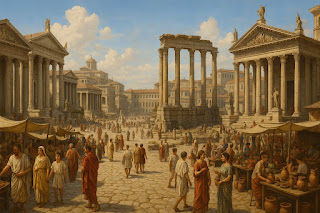
| Daily life in Ancient Rome’s bustling city. |
For the history buff, discovering Ancient Rome tells us stories about political discord, engineering feats, and indelible leaders. This post will take you through Rome’s expansion, notable events, and legacy. Much like the surprising tales found in 10 Shocking Historical Facts You Never Knew.
Timeline Highlights:
753 BCE: Legendary founding of Rome by Romulus
509 BCE: Republic established, replacing monarchy
44 BCE: Julius Caesar assassinated, the Republic’s decline begins
 |
| The Ides of March, 44 BCE. |
The last decades of the Republic were characterized by a variety of civil unrest and military conflict. This time, however, the vision of Julius Caesar as a legendary charismatic leader would take Rome’s territories by storm in military campaigns (the conquest of Gaul). For the first time in a long stretch of Roman history, Caesar would attempt to resolve social inequality and political instability with his reforms in 49 BCE, but while he was attempting to establish a reformist state, his power alarmed the Senate. Julius Caesar was assassinated in the Senate hall on the Ides of March, 44 BCE. This occasion thrust Rome into another civil war, ending only when Augustus (Octavian) vanquished the last of his adversaries to become the first emperor in Rome in 27 BCE. Augustus’ reign ushered in the Pax Romana, a time of relative peace, prosperity, artistic and architectural achievement, and cultural flourishing. Rome’s growth was also fueled by vast trade networks similar to those detailed in Trade and Commerce in Ancient Civilizations.
 |
| Julius Caesar, Rome’s famous leader. |
The life and death of Julius Caesar represent transitional periods in the life of a Republic opening into an Empire. He was an army leader, a genius, and a reformer, and he changed the Roman world. The conquest of Gaul opened the map of Rome. His reforms hoped to hold together the already menacing fractures of the Republic. No one would be quite as well-known as Julius Caesar in the ancient world. He has continued to influence the structure of the immense Empire born from the ashes of the Republic, and he has inspired intent to share and memorize his work as an intellectual stimulus for two thousand years. There is no doubt that Caesar is one of the most recognized and studied historical figures ever, for better or worse, as having such an effect on Rome and the West!
Which part of Rome’s history fascinates you most? Share your thoughts in the comments!
Beard, Mary. SPQR: A History of Ancient Rome. Liveright, 2015.
National Geographic. “Ancient Rome,” 2021.
UNESCO World Heritage Centre. “Rome,” whc.unesco.org/en/list/91
About the Author:
I’m Ali Mujtuba Zaidi, a passionate history enthusiast who enjoys exploring how the past connects to our present. Through this blog, I share my thoughts and research on ancient civilizations, lost empires, and the lessons history teaches us today.