Physical Address
304 North Cardinal St.
Dorchester Center, MA 02124
Physical Address
304 North Cardinal St.
Dorchester Center, MA 02124

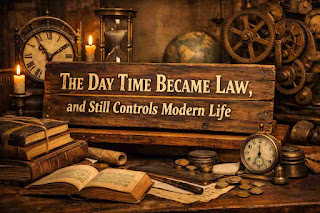
The Day Time Became Law, and How It Still Quietly Controls Modern Life
We treat time like a neutral force. Something natural. Something harmless.
But for most of human history, time was not something you checked. It was something you followed. The sun rose. You worked. Darkness came. You stopped. There were no minutes. No deadlines. No “late.”
Then time was rebuilt. Not by scientists. Not by philosophers. But by administrators.
The moment clocks became legal instruments, time stopped being descriptive and became regulatory. It did not just tell people what hour it was. It told them who was allowed to work, when they were allowed to move, and how long their labor was considered valuable.
 |
| Time did not just measure life. It quietly learned how to control it. |
This was not a technical upgrade. It was a political transformation.
The first mechanical clocks were not placed in homes. They were placed in monasteries, courts, and town halls.
They rang bells to enforce prayer, labor, court sessions, and public obligations. These bells did not ask. They announced. And people learned to obey them.
Once cities adopted clocks, time stopped being flexible and became fixed. Markets opened at specific hours. Gates closed at exact moments. Curfews became measurable. Fines could be calculated.
This marked the birth of time as law.
The same quiet administrative logic that erased entire populations through documentation is examined in how entire civilizations quietly disappeared from historical memory.
In ancient societies, arriving after sunrise was still “morning.” There was no punishment attached to minutes.
Once clocks entered legal systems, minutes gained moral meaning.
What survived in history increasingly depended not on what people did, but whether their actions fit recorded schedules. This survival bias is explored in why history reflects what survived rather than what happened.
Factories did not just use clocks. They enforced them.
Wages became hourly. Breaks became measured. Fatigue became scheduled. The body no longer followed hunger and rest. It followed alarms.
This is why modern burnout feels constant. The human brain evolved for cycles, not for minute-by-minute regulation.
We are biologically incompatible with the system we live inside.
Today your legal existence is still organized by time:
These systems classify who qualifies, who expires, who renews, and who disappears from eligibility.
Quiet administrative networks like these resemble early “offline dark webs” of governance explored in how secret legal frameworks controlled societies long before the internet.
Clocks created discipline. Calendars created compliance. Schedules created obedience.
Modern life feels rushed, not because life is shorter, but because your nervous system is trapped inside a machine that was never designed for human comfort.
You are not tired because you are weak.
You are tired because time became law.
ANS: Mechanical clocks entered legal life between the 13th and 15th centuries, first in monasteries and later in town halls, where they regulated court hours, markets, and curfews.
ANS: No. Time was measured in broad daylight segments, not precise minutes. Minute-based scheduling is a medieval and early modern invention.
ANS: Human biology evolved for natural cycles, not mechanical scheduling. Continuous alarm-based living causes chronic cognitive stress.
ANS: Yes. Hourly wages turned time into a financial unit, making human labor directly measurable.
ANS: Yes. Tax years, school years, benefit cycles, and retirement ages all operate through calendar-based authority.
The Day Time Became Law, and How It Still Quietly Controls Modern Life
We talk about time like it is natural, neutral, and inevitable. We blame it when we feel rushed. We fear it when we feel old. We chase it when we feel behind.
But time as you experience it today is not natural. It is engineered.
For most of human history, people did not live inside clocks. They lived inside daylight, seasons, hunger, and rest. Life did not happen by minutes. It happened by moments.
Then time was rebuilt into a machine. And that machine quietly became one of the most powerful systems ever created.
Early humans did not wake to alarms. They woke to light. They did not measure labor by hours. They worked until the task was done or the body demanded rest.
In ancient villages, there was no such thing as “late.” Arriving after sunrise was still morning. Arriving before darkness was still day.
This flexible relationship to time created societies that were slower, yes, but biologically aligned. Stress existed, but chronic time anxiety did not.
Time had not yet become authority.
The first mechanical clocks were not built for ordinary people. They were installed inside monasteries, churches, and courts.
Monks needed to pray at exact moments. Courts needed synchronized sessions. Cities needed curfews. Bells became the earliest time enforcement tools.
Once bells began regulating daily behavior, people learned to obey invisible rules rather than visible rulers.
This was the first time humans experienced abstract authority. You could not see time. You could only obey it.
Once clocks became part of legal systems, minutes gained moral meaning.
This quiet shift changed how societies defined responsibility. Effort mattered less than punctuality. Need mattered less than schedule.
The idea that “good people are on time” was born from clock law, not human nature.
Rome did not invent clocks. It invented synchronized time administration.
As the empire expanded, Rome faced a problem. It could not rule vast territories through tradition alone. It needed coordination.
January became the hinge of power.
Tax records were reset. Magistrate terms renewed. Courts reopened. Property rights were reaffirmed. Entire populations were reclassified.
Legal existence itself began to depend on appearing in registers at the correct time.
This is the same logic explored in how civilizations quietly vanished through paperwork rather than violence.
Being written into the new year’s records determined who could own land, inherit property, or file disputes.
Missing a window meant losing legal personhood.
Time became a gatekeeper.
This is why history remembers some people and forgets others, a pattern explained in why survival in records often mattered more than reality.
Factories monetized time.
Wages became hourly. Breaks became measured. Fatigue became scheduled.
Your body stopped deciding your day. A machine did.
This is why modern burnout feels constant.
Neuroscience confirms that the human nervous system evolved for cycles, not alarms.
Continuous scheduling produces chronic cognitive stress.
You are not tired because you are weak. You are tired because your biology is misaligned with your environment.
Today your legal life is still controlled by time windows:
Quiet systems of administrative control resemble those described in secret legal networks that governed societies long before the internet.
Clocks trained obedience. Calendars trained compliance. Schedules trained submission.
Modern society feels rushed not because time is scarce, but because the system is rigid.
You are not living in time.
You are living inside it.
ANS: Between the 13th and 15th centuries, mechanical clocks were installed in courts, monasteries, and city halls.
ANS: No. Time was measured broadly by daylight phases.
ANS: Because biological rhythms conflict with mechanical scheduling.
ANS: During the Industrial Revolution.
ANS: Yes. Taxes, benefits, education, and employment are still governed by time windows.